Jaghmaidze Accuses Journalistic Ethics Charter of Bias
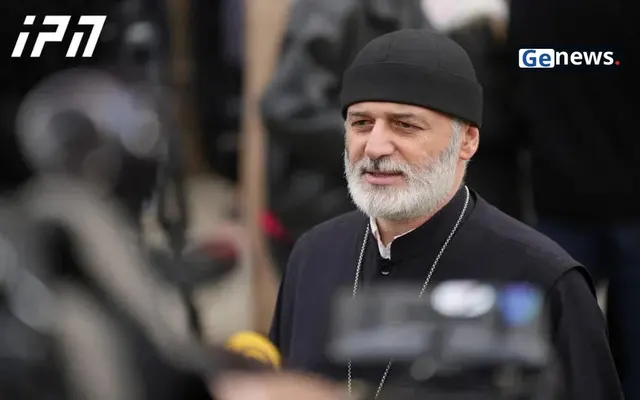
Andria Jaghmaidze, head of the Public Relations Service of the Patriarchate of Georgia and Dean, accuses the "Journalistic Ethics Charter" of biased approaches. He published the statement on "Facebook".
Jaghmaidze responds to the Charter's October 15 statement. The Charter assessed the Patriarchate's decision, on the basis of which representatives of "TV Pirveli" and "Formula" were not granted accreditation on October 14, on the Feast of Svetitskhoveli. The Charter considers this decision "alarming" and relies on the argumentation of Nodar Meladze: the Patriarchate did not explain to the television company's management the legal basis and specific reason for the decision, and in correspondence referred only to the incident that took place in Martvili on March 8, 2021. According to the Charter, drawing a parallel between this incident and the coverage of Svetitskhoveli is inappropriate, and restricting accreditation is discriminatory and an unjustified obstruction of journalists' work.
Jaghmaidze asks whether the Charter has really not noted any ethical violations by journalists since 2021, and whether it has not viewed video material showing disputed journalist conduct toward clergy. In his words, the Charter should first have focused on journalistic ethics, studied the reasons for the Patriarchate's decision more carefully, requested explanations from the Patriarchate's Public Relations Service to maintain objectivity, and not published a statement based on a single source.
According to the Dean, the basis for the decision was the repeated violation of the internal rules on church holidays by representatives of these television companies. He says that despite repeated warnings, journalists left the space designated for media on their own, followed clergy arriving for services with microphones and cameras in the church yard, and created a situation unsuitable for worship. Jaghmaidze states that the purpose of the decision was not to restrict information for the public or obstruct journalists' work, but to protect liturgical order and the interests of believers.
Jaghmaidze also recalls the Charter's declared mission: "Raising the social responsibility of the media through the protection of professional and ethical standards and the creation of self-regulation mechanisms". In his view, if the Charter devoted proper attention to this work, the situation might not have reached the "alarming" state that is now evident at many church holidays and events.
According to him, one of the Charter's areas of activity is reviewing facts of violations of professional standards by journalists on the basis of submitted complaints. The Patriarchate has not applied to the Charter with an official statement on these issues, however, according to him, the internet contains many reports and video materials filmed in different years that raise well-founded questions about journalists' conduct. Jaghmaidze also points out that the first principle of the Charter obliges journalists to respect the right to truth and accurate information, while the fourth principle requires the use of fair and conscientious methods in obtaining information. His question is why these principles are not taken into account when assessing journalists' conduct toward clergy.
According to the Dean, the Charter would have been much more useful if it had worked on educational and informational activities, cooperation with local and international organizations, and the promotion of journalistic ethics norms, rather than levelling accusations of discrimination and obstruction of professional activity against the Patriarchate based on an incompletely studied issue. Jaghmaidze believes that the Charter makes categorical assessments and does not give due attention to the arguments of the other side, in this case the Patriarchate.
According to him, this "biased" statement by the Charter indicates that the organization has become a "bureau defending radical media directed against the church". Jaghmaidze notes that protecting journalists' rights is important, but it should not mean turning a blind eye to violations of professional ethics or unconditionally releasing journalists from responsibility.
At the end of the post Jaghmaidze writes: "When the impartiality and professional responsibility of an organization calling for the protection of journalistic ethics itself becomes questionable, a completely logical question arises: has the time not come to create an ethics commission of the Journalistic Ethics Charter?!"
RELATED STORIES

Georgia's Population Is 3.941 Million, 2.053 Million of Whom Are Women

Environmental Agency Forecasts Heavy Rain and Flood Risk Until October 22
Public Defender Meets Students of Tbilisi's Green School

10 Finalist Teams Named in "Millennium Innovation Competition"

Seasonal Flu Vaccination Nationwide to Start October 21
Patriarch Calls for Love for All, Including Enemies, in Sermon
- Applications for Participation in IDP Monetary Compensation Programme to Be Accepted from October 19
- Sokhadze: Temporary Modular Schools to Be Set Up in Villages During School Rehabilitation
- Young Man Under 20 Injured in Shildа Village, Kvareli Municipality
- Zhorzholiani: 364 Agencies Participate in Internship Program, Around 1,500 Interns Selected
- One Person Detained Over Stabbing of Man in Dusheti
- Foreign Citizen Wanted by Interpol Red Notice Detained at Batumi Airport