Bezhashvili Cites Kobakhidze's 2008 Book at Constitutional Court: Restoring Territories by War Is Not Grounds for Party Ban
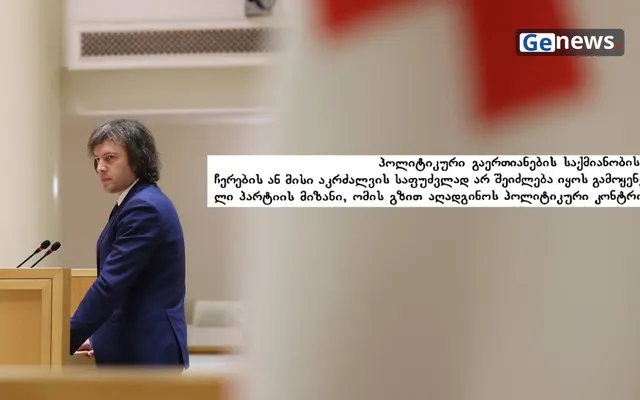
Levan Bezhashvili, a representative of the United National Movement, recalled an excerpt from Irakli Kobakhidze's 2008 book "Law of Political Associations" at the Constitutional Court on October 27, during the hearing of the case on banning opposition parties. Georgian Dream's lawsuit seeks the ban of the UNM, among other grounds, on the basis of violating the territorial integrity of the country, and in this context refers to the events related to the August 2008 war.
In the part cited by Bezhashvili, Kobakhidze writes: "The goal of a political association cannot be used as grounds for banning it if the goal is to restore political control by war over territories seized by separatist movements or foreign states, territories over which Georgia's jurisdiction extended as of December 21, 1991".
According to the book, war waged to restore political control over such territories should be considered a defensive war. Article 98 of the Constitution declares only the waging of a defensive war a sovereign right of Georgia. Kobakhidze explains that under the Constitution, propaganda of war and violence is grounds for banning a party, but this implies external aggression, even to return historical territories, and not Abkhazia and the Tskhinvali Region. According to him, a call to restore jurisdiction over so-called lost territories by war cannot be considered propaganda of violence either.
The book also states that propaganda should be considered a party's systematic call to carry out external aggression or violence against various groups of the population. One-time statements by party leaders and members cannot be considered propaganda and cannot provide a legal basis for the court to suspend or ban a party. Real actions may also be considered propaganda, for example, members preparing for military operations, attempts to launch military operations with its own forces, or acts of violence of a regular nature.
Although the book interprets the Constitution in force in 2008, the provision on banning a party for the right to defensive war and for propaganda of war and violence is identical in the Constitution in force today. Kobakhidze also notes that the Constitutional Court is authorized to ban the activity of a party whose aim is to violate the territorial integrity of Georgia.
In the lawsuit of 88 deputies of "Georgian Dream" it is written: "In 2004-2008 the then government of Georgia systematically conducted military rhetoric, displayed militaristic aspirations and carried out confrontational actions and measures aimed at fueling conflict... The culmination of these events was August 2008, when the then government of Georgia created the ground for the entry of an occupying force into the Tskhinvali Region". The plaintiff claims that from 2004 the UNM systematically carried out actions that contributed to the occupation of territories, while attempts to start military operations against Russia continued after 2012.
According to Bezhashvili, the plaintiff, relying on the conclusion of the Tsulukiani commission, is trying to assign responsibility for the start of the 2008 war to the then government, which he says is a direct copy of the Russian occupation propaganda narrative. In his view, this position contradicts two international decisions: the Grand Chamber judgment of the European Court of Human Rights in the case "Georgia v. Russia" and the decision of the International Court of Justice in The Hague.
According to Bezhashvili's assessment, if the Constitutional Court upholds the lawsuit and declares the then ruling party unconstitutional on the motive of starting the war, Georgia would, through its own highest court, reject the victories of the Strasbourg and The Hague courts. He says Russia would gain a legal argument on the international arena, as if Georgia itself had acknowledged that the Georgian side started the war. This, in his words, would undermine the policy of non-recognition of occupied territories and open the way for other states to recognize the independence of Abkhazia and the Tskhinvali Region. Bezhashvili says Georgia would lose the legal and political support of Western partners in the UN, the EU and the OSCE, and a retroactive threat would be created for Georgian servicemen at the domestic state level.
Bezhashvili stated: "Even if we assume that the goal of the government was to restore the territorial integrity of Georgia by the use of military force, this does not indicate the unconstitutionality of the party's goal, or an intention to violate the territorial integrity of Georgia". According to him, many quotations could be drawn from many books, but they decided to cite this provision precisely from the book of Kobakhidze, one of the leaders of "Georgian Dream".
RELATED STORIES
Gorduladze: 150 Parties Banned in Europe in Recent Decades, 22 in Ukraine, 8 in Moldova
Sioridze: Ivanishvili and Georgian Dream Face Severe Political Price in Form of Personal Sanctions
Davitaia: Judges Who Decide on Party Ban Will Be Sanctioned by UK and US
Bibilashvili: Kobakhidze's Resignation Points to Instruction Received by Constitutional Court

Parliament Allows Casinos to Host International Gambling Tournaments in First Reading
Mamuka Pifia on Zurabishvili appointment: it is effectively the restoration of diplomatic relations
- Makhashvili: Claiming Serbian Elections as Own Victory Shows Opposition's Illusions
- Anna Tsitlidze at Constitutional Court: Ivanishvili's 2012 Statements Would Be Absurd as Basis for Banning United National Movement
- Furalava: After Parties Are Banned, We Will Leave Parliament and Our Mandates
- Kakhiani: "National Movement" Had No Legal Counterarguments at Constitutional Court
- Khvedelidze: Banning Parties Moves Country into Declared Dictatorship
- Samadashvili: Banning Parties Will Be the Beginning of Additional Problems for Ivanishvili