Meloni: Surrender Is Not Peace, It Is Conquest
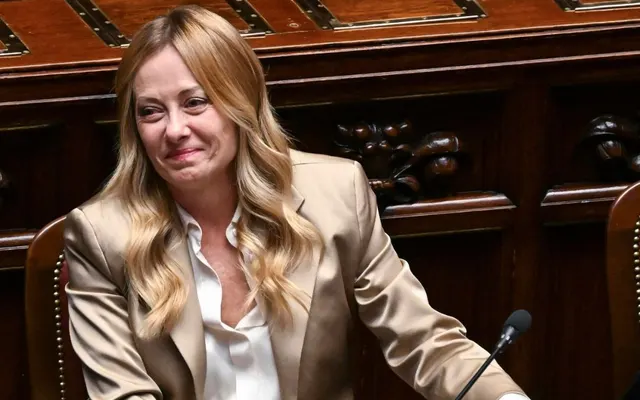
Italian Prime Minister Giorgia Meloni appeared before parliament ahead of the October 15-16 European Council summit to report on the government's position. She spoke about Italy's interests and its country's policy within the European Union, and explained why the government will not change its course of supporting Ukraine.
Meloni said that Russia has launched a new autumn campaign against Ukraine. According to her, Moscow, unable to advance on the front, is increasingly striking civilians: power plants, residential buildings, hospitals and also buses that carry people to work, as happened in Kramatorsk. The prime minister assessed that Russia is trying to bring the Ukrainian people to their knees through terror, cold and darkness, because it has failed on the battlefield. According to Meloni, since the beginning of the year Moscow has occupied very little territory, while in September alone it lost a large part of the territory it had seized in recent months.
The prime minister said that this deadlock was created through the courage of Ukrainians and the support of the West, including Italy. In her view, it is the only effective tool that can bring Russia to serious negotiations. Meloni acknowledged that the debate on this issue is heated in parliament, including within parliamentary groups, but, in her words, everyone wants peace and the difference lies in the way to achieve it.
"Support for Ukraine is not an alternative to peace, it is what makes peace possible. [...] Surrender is not peace, it is conquest," Meloni said. According to her, if Ukraine stopped defending itself tomorrow, it would not bring peace but the occupation of a European nation and the return of Soviet-style imperialism. The prime minister added that a just peace must be lasting and that it protects Europe and Italy's interests. The government's position does not change: support for Kyiv, with particular attention to the civilian population, pressure on Moscow and Euro-Atlantic unity remain the pillars of its actions.
Meloni described as risky the decision by US President Donald Trump to lift the embargo on Russian diesel. She said that the rise in fuel prices is mainly caused by the war in Iran and not by the conflict in Ukraine. In her words, granting legitimacy to Moscow while its bombs continue to fall on Ukrainian cities, securing new revenues to finance the war and covertly weakening the sanctions lever are elements that run counter to the efforts Western countries, including the US, have made so far to force Putin to sit at the negotiating table.
Meloni calls for the 27 member states of the European Union to appoint an authoritative figure, with a mandate from all, who could voice Europe's position in negotiations to end the Russia-Ukraine war. According to the prime minister, Europe must speak with one voice and must not give a pretext to those who are interested in division. In her assessment, a Europe split over formats presents itself as infantile, and this is the only real gift to Moscow.
Meloni said that the European Council is considering the escalation of Russian hybrid attacks. According to her, the hybrid threat has become another "new normal" of this troubled era. The prime minister added that whoever says that more security means fewer hospitals is lying and knows that they are doing so; security is also a precondition for well-being.
Meloni also spoke about the need to increase security in Italy and Europe. According to Meloni, Europe will have to make increasingly difficult choices in order to remain competitive, secure and a leading player in the world. She named the war in Ukraine, instability in the Middle East, intensifying global economic competition, geopolitical tensions affecting supply chains, fuel prices and the cost of living, as well as hybrid threats and migration pressure. The prime minister said that in recent years the government has chosen an active and continuous presence on the international stage, because national interest is protected when the country takes part in processes that matter to it and does not merely adapt to outcomes.
RELATED STORIES
- Zelensky: We are losing a strong partner in the form of the US
- US Congressional Bipartisan Group to Protest Restrictions on Intelligence and Starlink for Ukraine
- Burnham: Zelensky Will Not Leave Britain Empty-Handed
- Meloni: US-Russia Diesel Deal Is a Very Risky Step
- Rutte: Russia Is Failing on the Battlefield in Ukraine and Cannot Intimidate NATO
- European Commission allocates €2.86 billion to Ukraine for defence needs