Japaridze at Constitutional Court: "Dream" Ban on Parties Paves Way for Constitutional Coup
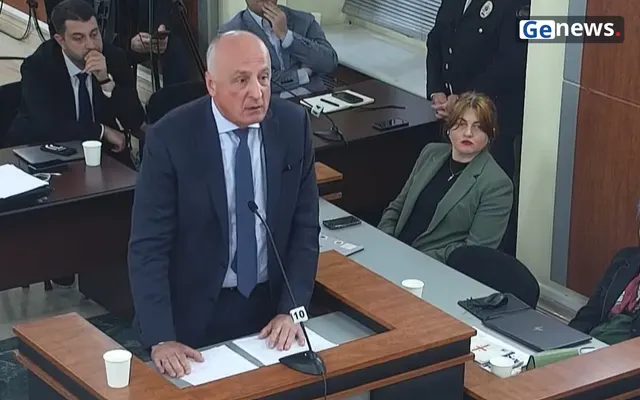
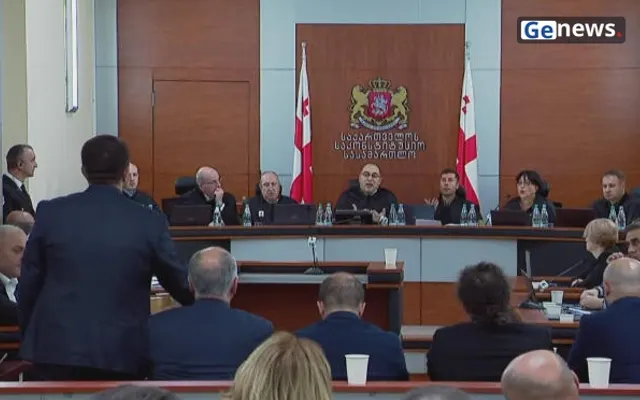
Badri Japaridze, leader of "Lelo-Strong Georgia", told the Constitutional Court, where the Georgian Dream lawsuit on banning political parties is being considered, that the ruling party is seeking to ban Georgia's independent statehood rather than several political parties. According to him, by banning opposition parties the ruling force will take political choice away from voters and entrench at the constitutional level the "de facto usurped government".
Japaridze said there is reason to assume that by banning parties, "Georgian Dream" is paving the way for a constitutional coup. In his explanation, the ruling force wants to remove more than a million differently minded voters, by its own calculations, win a constitutional majority and entrench power at the constitutional level. Japaridze said "Dream" aims to govern the country in a Russian-autocratic style and to isolate Georgia from the free world. He added that their presence here aims to defend Georgia's independence and freedom from a government that has stepped outside the framework of the constitution.
On the demand to ban "Lelo", Japaridze said the party since December 2019 has aimed to strengthen state institutions, the independence of the courts and rapid progress on the path of European integration. According to him, in response the party has for the seventh year been under politically motivated criminal prosecution inspired by "Dream". Japaridze recalled the parliamentary boycott announced after the 2020 elections, which was ended on the basis of the agreement reached in 2021 through the mediation of Charles Michel. In his statement, "Georgian Dream" left its obligations unfulfilled by withdrawing from the agreement.
Japaridze said the ruling party considers signing the "Georgian Charter" proposed by Salome Zurabishvili a crime and presents it as evidence that five parties form one organism. He said signing the charter was a legitimate act and serves the implementation of Article 78 of the constitution. He cited the example of Germany, where Christian Democratic and Social Democratic parties are in a coalition government, and said that coincidence of positions does not turn parties into one organism.
On the charge of not entering parliament, Japaridze said his mandate was terminated in 2022 by "Georgian Dream" itself on the basis of a decision by Judge Arevadze, which the appeals court panel headed by Jorbenadze upheld. According to him, the decision is being appealed at the Strasbourg court, which took the case into proceedings within a short time, and they are awaiting a decision. Japaridze recalled that in 1990 they defeated the Communist Party in elections, in 1991 he signed the declaration of independence, and then his parliamentary mandate was terminated by force of arms.
Citing Article 42 of the constitution, he said at least 50% of the members of a parliamentary inquiry commission must be opposition representatives, while "Georgian Dream" formed the commission by disregarding this requirement. Japaridze also said that one of the lawsuit's pieces of evidence, the facilitation of unlawful attacks on business in 2004-2012, which is confirmed by the conclusion of the parliamentary inquiry commission, is a violation of the presumption of innocence and direct defamation, because there is no court conclusion. In his explanation, of the three or four persons listed in the inquiry commission's conclusion, only Akhvlediani applied to a court, and none of the instances satisfied his claim.
Japaridze said that if the crime of a person on an electoral list is grounds for abolishing a party, then by this logic "Georgian Dream" should also be abolished, because its members committed corruption crimes in high positions. He named sovereignty and territorial integrity as another dangerous aspect of the lawsuit, and said the lawsuit develops the logic that Georgia itself created the ground for Russia's aggression in 2008. In his assessment, this is an attempt to shift responsibility from the aggressor to the victim, and granting the lawsuit could make Russia's "non-irritation policy" a constitutional obligation. Japaridze called on the Constitutional Court to fully take responsibility so that the principle of non-recognition of occupied territories is not endangered.
RELATED STORIES
Samadashvili: Our only demand is that Elene Khoshtaria be released from prison
Cheishvili: Respondent Side Has an Acute Deficit of Legal Arguments
Nadaraia to Gvaramia: I Have No Information on Judges' Corruption

Ana Tsitlidze: Bringing Khoshtaria to This Condition Is Georgian Dream's Responsibility

Gvaramia at Constitutional Court: Under Plaintiff's Standard, Georgian Dream Itself Is the Party to Be Banned
Co-Chairs of UN, OSCE and EU Meet Bigvava in Sukhumi Ahead of 68th Geneva Round
- Lemonjava at Constitutional Court: Georgian Dream's Lawsuit Repeats Russian Doctrine Provisions
- Kobakhidze Meets Kwasniewski: Opioid Substitution Therapy Benefits 14,000 Patients
- Constitutional Court to resume hearing on party case tomorrow at 11:00
- Protesters Shout "Slaves" at Georgian Dream Members Outside Constitutional Court

- Cheishvili: Opposition Insulted Hundreds and Thousands of Citizens
- Artkmeladze: Banning Parties Will Destroy in One Stroke What Was Built Over 35 Years