Bibilashvili to Constitutional Court: Lawsuit Seeks to Legitimize Russia's 2008 Aggression
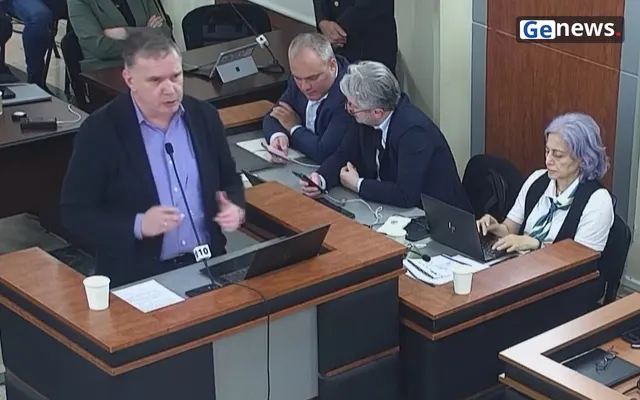
The Constitutional Court's consideration of the "Georgian Dream" lawsuit seeking the ban of opposition parties is still at the explanation stage. After Archil Gorduladze, the position was presented by Zaza Bibilashvili, a member of the United National Movement.
According to Bibilashvili, one of the main goals of the lawsuit is to legitimize Russia's military aggression through a court decision. The second goal, he said, is for "Georgian Dream" to remain in power indefinitely under non-competitive elections.
"The aim of the lawsuit is to confirm at the constitutional level the claim of the occupying state, the Russian Federation, that its military aggression of 2008 was legitimate, because Georgia created the basis for it. The result will be exactly this – the legitimization of the military aggression of the Russian Federation at the level of a decision of the Constitutional Court of Georgia," Bibilashvili said.
The lawsuit claims that the actions of Mikheil Saakashvili's government contributed to the escalation of the conflict, the August 2008 war and the occupation of territories. The document mentions warlike rhetoric and a confrontational policy pursued in 2004-2008, the holding of alternative elections in the Tskhinvali region in 2006, which the plaintiffs see as an indirect legitimization of separatist structures, the creation of the provisional administrative-territorial unit of South Ossetia in 2007, and the hostilities of August 2008.
To strengthen their arguments, the plaintiffs cite the opinion of Thea Tsulukiani, a resolution of the Parliamentary Assembly of the Council of Europe, and the 2009 report of the Tagliavini International Fact-Finding Mission.
According to Bibilashvili, the plaintiff side in the lawsuit confuses political and legal responsibility and does not distinguish between the state and a political party. "As a result, the constitutional order is replaced by the power of the ruling party," he said.
In his assessment, if the goal of the plaintiffs is to create a healthy opposition, the court should consider within what timeframe they believe this is achievable. Bibilashvili believes that a healthy opposition cannot be created by 2028, which, if the lawsuit is granted, will lead to "Georgian Dream" remaining in power under non-competitive elections.
He also focused on statements according to which, if any party gains the chance to overcome the electoral threshold, it too may be banned. "It is obvious that the lawsuit lacks a legitimate purpose," Bibilashvili said. According to him, the plaintiff side may deny that it wants such an outcome, but if the lawsuit is granted, the result will still be the same.
Bibilashvili assessed the lawsuit as an example of seizing the constitution, autocratic legalism and abuse of legal proceedings. According to his statement, the aim is the usurpation of power by one party, depriving citizens of a real political choice and de facto legalizing one-party rule.
"There is no such precedent in the history of independent Georgia, neither during the First Republic nor after the restoration of independence, after 1991. Such things happened only during the Soviet occupation, and now we are on the verge of such a thing," he said.
Bibilashvili noted that paragraph 3 of Article 3 of the Constitution prohibits the seizure of power. According to his explanation, the threat of usurpation does not arise only during a violent coup; it also exists when the ruling majority, through legal forms, excludes a change of government through elections. Autocratic legalism, in his words, is a form of democratic erosion, when the dismantling of the system proceeds through formally legal instruments.
According to him, the lawsuit cites the European Court of Human Rights cases selectively, and the model of party bans is cited out of context. Bibilashvili assessed that using the Constitutional Court against the competitors of the ruling party is contrary to its purpose, since the function of this institution is to protect democratic competition.
RELATED STORIES

Bibilashvili at Constitutional Court: Investigation of Kakha Kaladze's Brother's Murder Became Possible Only After 2003
Government Asks Parliament to Assign Deputy Minister Prime Minister's Special Representative Role
Kereselidze: If Party Is Banned, Its Mandates Will Have No Force
Papuashvili on Recommendation to Suspend Patarkiladze's Powers: "We Have Trust in the Prosecution. Let's See Whether They Investigate!"
Papuashvili: Radical Opposition Would Have Lost in Serbia Too, and Has No Chance of Winning in Georgia
Papuashvili: European Commission Uses Soviet Methods Towards Georgia
- Gorduladze: We Would Have Acted Out of Narrow Party Interest, Would Not Have Filed Suit Against "Collective National Movement"
- Matikashvili on Opposition Rally: Society Saw What Support Radicalism and Agentura Have
- Makа Bochorishvili to Take Part in Sofia Economic Forum in Bulgaria

- Constitutional Court to Resume Hearing on Case to Declare 5 Parties Unconstitutional
- Tsutskiridze Urges Citizens to Support Political Parties

- Lemonjava: It Is Time to Move from Containment to Attack