Papoyan: Eurasian Union Exaggerates Consequences of Armenia's Exit
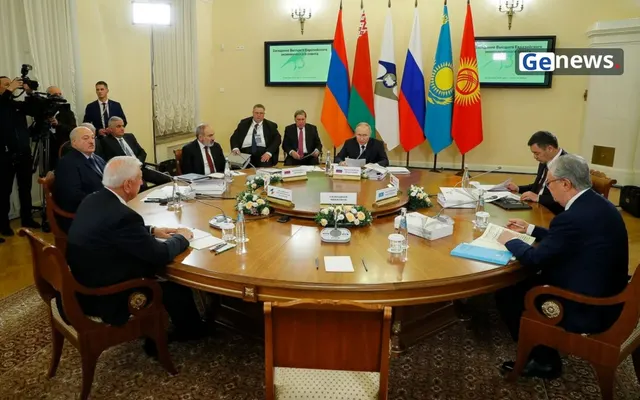
Armenian Economy Minister Gevorg Papoyan says the latest report of the Eurasian Intergovernmental Council exaggerates the economic consequences that leaving the Eurasian Economic Union (EAEU) could bring for Armenia. Foreign Minister Ararat Mirzoyan said they have not yet managed to fully review the document.
On October 20, four members of the Eurasian Intergovernmental Council, Russia, Belarus, Kazakhstan and Kyrgyzstan, published a report of about 70 pages. It concerns the consequences of Armenia joining the European Union and leaving the EAEU. According to the report, if Armenia leaves the union, it will suffer major economic losses, while the impact on other members will be almost insignificant.
Papoyan told News.am that the figures in the report are exaggerated by 50%, and that the Armenian side had already presented accurate data earlier. According to him, the negative impact on the economy will not be significant and its scale is -0.61%. If the gas price changes, the impact will be 5–7% or more, but it will not be devastating. The report, however, says the most significant consequences may appear in the energy sector, due to changes in gas supply conditions and the loss of benefits provided by free trade agreements.
On October 22, at a press briefing, Pashinyan said that EAEU member states cannot expel another member. "It is interesting why they do not expel us from the Collective Security Treaty Organization [CSTO], while regarding the Eurasian Economic Union, for the first time in our history, the metropole does not attract us to itself but indirectly tells us: 'expel yourselves from us'," Pashinyan said. When asked about the forecast of economic losses, he briefly replied: "We will see."
On October 21, Mirzoyan said the report is quite extensive and the Armenian side is only now beginning to review it in order to formulate a response. "We are not aware of any legal mechanism on the basis of which a certain number of Eurasian Economic Union member states could expel any other country or suspend its membership. However, we will study the issue and give an answer. The well-being of our citizens, traditional trade relations with the Russian Federation and other countries of the Eurasian Economic Union are important, but the most important thing is Armenia's sovereignty and independence," he said.
The report acknowledges that the EAEU treaty does not provide members with a mechanism for suspending each other's membership, but it points to two possible legal routes. The first is Article 3 of the treaty, which obliges members not to adopt measures that could threaten the goals of the union. The second is the 1969 Vienna Convention on the Law of Treaties, under which other parties may jointly suspend the operation of a treaty with respect to a state that has materially breached it. This suspension could last until Armenia holds a referendum and decides whether it chooses the Eurasian Union or the European Union. In June, Russian Deputy Foreign Minister Mikhail Galuzin said the only way out provided by the treaty is voluntary withdrawal, which Armenia has not yet started.
Papoyan said the Ministry of Economy, the Central Bank and the Ministry of Finance have created a working group that will assess the consequences of a possible exit from the EAEU. Armenia has applied to the Eurasian Economic Commission, whose session will take place on November 3.
According to the report, in 2025 Armenia's trade with EAEU countries amounted to almost 8 billion dollars: exports were 3.2 billion and imports were 4.8 billion dollars. This is 37.8% of Armenia's total trade turnover. The share of trade with Armenia in Russia's trade turnover was 0.91%, in Belarus's 0.28%, in Kazakhstan's 0.05%, and in Kyrgyzstan's 0.02%. Some 97–99% of the decline in trade and services would fall on Russia, while the redistribution of lost volumes could be possible within the EAEU internal market. For all four states, the direct decline in exports and imports is less than 1%, with the largest drop for Russia: 0.55% in exports and 0.65% in imports.
The document says that in 2025, when Armenia's parliament passed a law launching the process of joining the European Union, the government supported the bill, although this contradicted obligations undertaken within the EAEU. According to the report, despite pressure, Armenia does not plan to hold a referendum. Papoyan stressed that Armenia has already clearly stated its position. In July, in response to a Russian demand, Pashinyan said a referendum would be possible only after Armenia submits an official application for EU membership.
"The fact that Armenia has adopted a law launching the process of joining the European Union does not mean that Armenia is currently ready for EU membership," Pashinyan said in August. The report concludes that Armenia is trying to preserve the benefits of EAEU membership while negotiating with the EU, which raises questions about its status in the union. According to the document, membership in both unions simultaneously is impossible both legally and practically, as they have their own supranational rules. The report lists the agreements of both unions with other countries, many of which contradict each other. It also notes differences in product requirements: the EAEU applies stricter restrictions on antibiotics, ractopamine, nitrates, certain pesticides and genetically modified organisms (GMOs).
In September, the Council of the European Union adopted temporary measures liberalizing trade for Armenian products, covering about 80% of Armenia's exports to the EU. These measures came into force against the backdrop of Russia still imposing restrictions on Armenian exports. Four states say that Armenia's exit from the EAEU is of no interest to them, and they present the possibility of suspending membership as respect for the right of the Armenian people to determine their own future.
RELATED STORIES

Over 119 Thousand Visitors From China Entered Georgia in January-September
Rosselkhoznadzor: Georgia to Buy One Million Doses of Animal Vaccine from Russia
Zakharova: Restrictions on Georgian Beverage Imports Have No Political Basis

US Dollar Official Rate Set at 2.5978 Lari

State Property Agency Puts 10 Former Sanatoriums in Tskaltubo Up for Auction
Georgia's Foreign Trade Turnover Exceeds $20.5 Billion in January-September
- Nana Keinishvili Leaves Post as National Bank Council Member

- US Considers Easing Sanctions on 'Shadow Fleet' Vessels
- Georgian Dream: IMF Forecast Shows Georgia Will Be Among Top Three World Economies by Growth in 2031
- Trump: Taiwan Agrees to Buy 30% of Alaska Project's LNG
- Kvijinadze: Salaries and Pensions Growing Faster Than Prices

- US Dollar Official Rate Becomes 2.5989 Lari