Lemonjava at Constitutional Court: Non-Recognition of Elections Is Not Overthrow of Constitutional Order
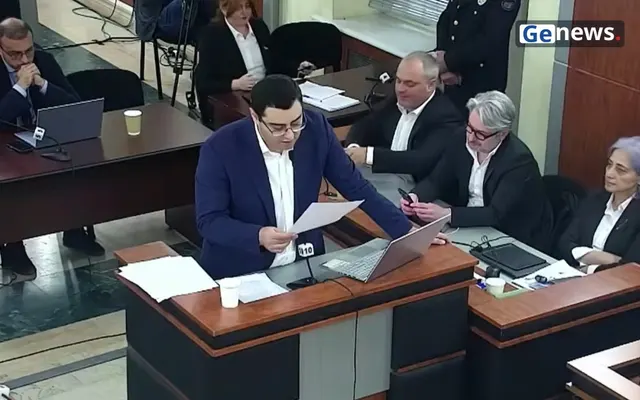
At the Constitutional Court, where the Georgian Dream lawsuit on banning opposition parties is being considered, Giga Lemonjava, representative of the "Coalition for Change", explained why non-recognition of election results, declaring the ruling force illegitimate, demanding new elections and a parliamentary boycott should not be assessed as activity aimed at overthrowing the constitutional order.
He said these are four different issues, and expressing a political position should not be equated with an attempt to change the constitutional order by violent means. Lemonjava pointed to international legal standards and the case law of the European Court of Human Rights. According to him, Article 23, Paragraph 3 of the Constitution refers only to the fourth category, violent overthrow, while the first three constitute protected political activity.
According to Lemonjava, a demand for new elections is a demand to activate the existing system's mechanisms. He recalled the European Parliament resolution of November 28, 2024, which was adopted by 444 votes to 72. He said the condition of legal remedies has also been met: opposition parties appealed the election results first to the Election Administration and then to common courts, while the President and 30 opposition MPs applied to the Constitutional Court. On November 29, 2024, the court refused by ruling to admit the lawsuits for substantive consideration. Lemonjava assessed that the plaintiff cannot simultaneously say that the opposition bypassed legal avenues and that it was denied access to them.
Regarding the refusal of mandates, he invoked Article 39, Paragraph 5, Subparagraph "a" of the Constitution, under which a Member of Parliament's powers terminate early if he or she renounces them by personal statement. Lemonjava said that exercising a right granted by the Constitution cannot amount to overthrowing the constitutional order. He noted that on February 5, 2025, Parliament satisfied the statements of 49 deputies of the defendant parties and terminated their mandates, and on July 2, 12 deputies of "Gakharia for Georgia" had their mandates terminated without a statement. His question is, if refusing a mandate is a manifestation of an unconstitutional aim, why did Parliament formalize the realization of this aim under Article 39.
On boycotts, Lemonjava cited the position of the Venice Commission: an organized and prolonged boycott cannot be entirely excluded as a legitimate form of political conduct, and is permissible in rare and extreme circumstances when the legitimacy of Parliament is in question due to the actions of the majority. He said that the attempt to ban a party over a boycott confirms that "Georgian Dream" is acting in a manner the Venice Commission recommends against and is trying to make it impossible or very difficult for a minority to become a majority.
On violent overthrow, Lemonjava said that any claim of violence or calls to it must be a separate fact, proven by primary sources and by affiliation with the party's statutory bodies, and not derived from non-recognition. According to him, the main flaw of the lawsuit is that it moves the first, second and third categories into the fourth through the concept of "legitimacy".
Lemonjava noted that in a democratic state, government and state must be separated. Under Article 3, Paragraphs 1 and 2 of the Constitution, the people are the source of state power. Making the legitimacy of a particular government's mandate or of election results contestable, he said, does not amount to a denial of statehood, sovereignty or the constitutional order. Criticism of government, calls for its change and demands for new free and fair elections are an essential part of the democratic process. The Venice Commission calls this "keeping open channels for political change".
He said the legal force of election results does not depend on the recognition of any party: the results are established by the CEC's summary protocol and by Parliament's recognition of members' powers. Neither the Constitution nor legislation imposes an obligation on anyone to recognize election results, so non-recognition violates no legal obligation and produces no legal consequence. Lemonjava added that Article 23, Paragraph 3 describes actions, while non-recognition is not an action but an assessment.
Lemonjava also said that Parliament has been functioning for two years, adopting laws, electing officials, and that the lawsuit itself was filed with the signatures of members of this Parliament. He asked, if non-recognition is an overthrow of the constitutional order, how can the plaintiff be represented in the name of an institution of this order that is fully functioning. According to him, reading by "Georgian Dream", Article 23, Paragraph 3 would threaten any party that disputes election results, which leads to absurdity and contradicts the principle of equality of parties guaranteed by Article 3, Paragraph 4 of the Constitution.
On the European course, he recalled Article 78 of the Constitution, under which constitutional bodies are obliged to take all measures within their powers to ensure Georgia's full integration into the European Union and NATO. Lemonjava said that the opposition's assessment that the ruling force has deviated from this course, and its appeals to EU institutions and partner states, are a demand to implement Article 78. Providing international partners with information on electoral violations and calling for sanctions against responsible persons is a political statement protected by freedom of expression, while the decision on sanctions belongs to the recipients. He added that a demand for personal sanctions is also in the European Parliament resolution of November 28, 2024, so banning a party solely because it shares the European Parliament's position is inadmissible.
Lemonjava also spoke on the so-called "non-separation" theory, under which the lawsuit holds other parties responsible for the statements and actions of one party. He said that according to European standards, banning a party that is based only on the individual actions of members, where there is no proper basis for attributing them to the party, contradicts freedom of association. Therefore, automatically attributing one party's statements or individual persons' actions to other parties and demanding their ban on that basis is inadmissible.
The Constitutional Court has now been considering the lawsuit to ban parties for the fifth day. The process is at the stage of explanations, to be followed by the question-and-answer stage. Through the lawsuit, 88 Parliament members request that the activities of five political parties be declared unconstitutional, and that they be banned and deregistered. According to the plaintiffs, the aim of these parties' activities is to overthrow the constitutional order of Georgia or change it by force, undermine the country's independence and violate its territorial integrity. The lawsuit concerns "United National Movement", "Coalition for Change", "Strong Georgia-Lelo", "Gakharia for Georgia" and "Federalists".
RELATED STORIES
Kobakhidze Meets Kwasniewski: Opioid Substitution Therapy Benefits 14,000 Patients
Constitutional Court to resume hearing on party case tomorrow at 11:00

Protesters Shout "Slaves" at Georgian Dream Members Outside Constitutional Court
Cheishvili: Opposition Insulted Hundreds and Thousands of Citizens
Artkmeladze: Banning Parties Will Destroy in One Stroke What Was Built Over 35 Years

Faruliava: Gambling Business Is a Leading Business That the Ruling Party Gives a Green Light To
- Kipiani: Lawsuit Has Revived Ratings of Parties Named for Ban

- Gorduladze: Parties Named in Lawsuit Tried to Change Government by Force Six Times in 2019-2025
- Gvaramia at Constitutional Court: We Are Going Back to Where Gamsakhurdia Pulled Us Out Of

- Butikashvili: Banning Parties Will End Georgia's Existence as a Democratic Country

- Gotsiridze: Agreement Signed with Azerbaijan Does Not Allow Gas Tariffs to Be Maintained

- SJC: Opposition Not Given Adequate Opportunity to Present Evidence in Party Ban Case